1. The Collateral Movement Problem
Crypto lending has surpassed $73 billion in outstanding collateralized borrowing as of Q3 2025, eclipsing the prior cycle’s peak. Collateralization ratios are higher, on-chain transparency is standard, and uncollateralized lending has largely been eliminated from institutional practice. Yet underneath this growth lies a persistent structural deficiency: the requirement to physically move collateral to the lender or a third-party venue in order to originate a loan.
This is not a minor friction. It is the defining constraint of institutional credit in digital assets. When a market maker borrows against BTC, ETH, or tokenized treasuries, the standard workflow requires transferring that collateral out of the borrower’s custodian, into the lender’s custody or an exchange margin system. This transfer generates counterparty risk that did not need to exist, creates settlement delays ranging from hours to days, and forces borrowers to choose between capital efficiency and asset security.
Figure 1: Tokenization Charging Ahead
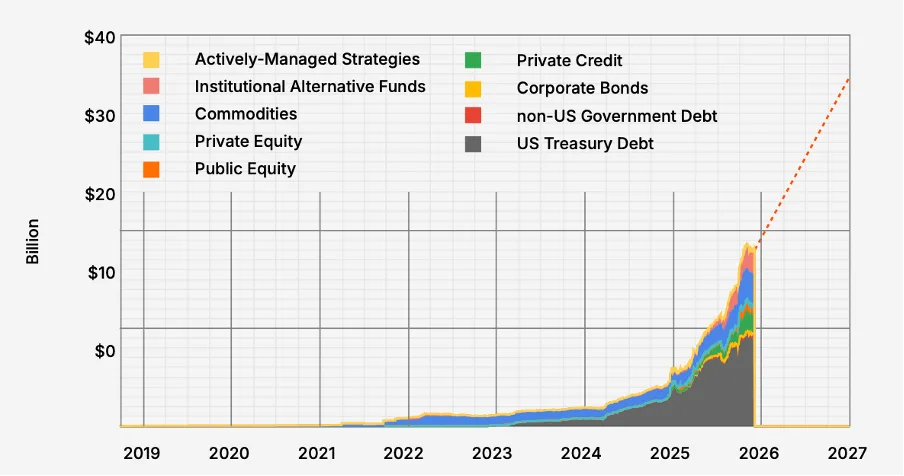
The problem is compounded by the rise of tokenized real-world assets. Presto Research’s 2025 year-end outlook projects the USD-denominated non-fiat RWA market cap to double in 2026, ending the year around $36 billion, driven by continued growth in tokenized credit instruments, commodities, and early-stage tokenized equities. Products like BlackRock’s BUIDL and Franklin Templeton’s FOBXX are attracting institutional allocators precisely because they combine yield, compliance, and blockchain-native composability. But these assets sit in qualified custody, and the moment an institution wants to borrow against them, the existing infrastructure forces a choice: move the asset or negotiate a bespoke bilateral agreement lasting weeks.
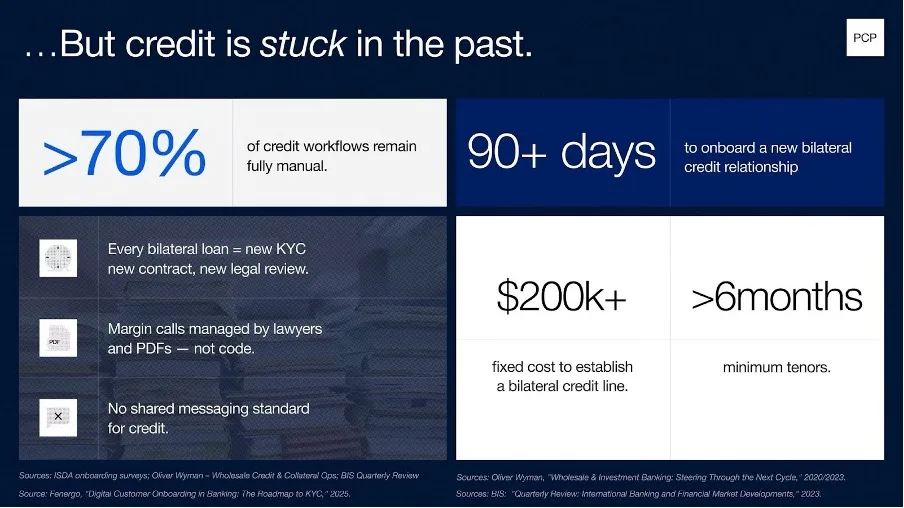
The numbers illustrate how deep the problem runs. Over 70% of credit workflows in institutional digital asset markets remain fully manual. Onboarding a new bilateral credit relationship takes over 90 days. The fixed cost to establish a single bilateral credit line exceeds $200,000, with minimum tenors of six months or more. Every bilateral loan means new KYC, a new contract, and a new legal review. Margin calls are managed by lawyers and PDFs, not code. There is no shared messaging standard for credit.
2. Why Existing Models Fall Short
Figure 2: Structural Challenges in Crypto Credit Markets
Bilateral OTC lending remains the dominant model. A borrower and lender negotiate terms, execute legal agreements, and arrange collateral transfer. This process produces loans but does not scale. Origination takes days to weeks. Costs run between 80 and 200 basis points in overhead before interest is even charged. For a market maker seeking to borrow $20 million for 48 hours against tokenized treasuries, the bilateral model is economically irrational.
DeFi lending protocols like Aave, Compound, and Morpho have solved parts of this problem through permissionless access and automated liquidation. But they operate on a wallet-native model: collateral must be deposited into a smart contract. DeFi optimizes for open and permissionless capital. Institutions require verifiable and legally enforceable credit. DeFi provides protocol-driven floating rates; institutions need fixed rates and defined tenors. DeFi is overcollateralized without legal enforceability; institutions need undercollateralized access with legal recourse. Collateral moves into smart contracts; institutions need collateral locked at qualified custodians.
Prime brokerage platforms such as FalconX, Hidden Road, and Bridgeport offer a more institutional interface but face structural constraints. Prime broker leverage is balance-sheet heavy and infrastructure constrained. Internal capital caps client leverage, credit increases require risk committee approval, and capital is tied up even when unused. There is no standardized RFQ mechanism to external lenders, liquidations are not deterministically linked to loan settlement, and collateral release is manual.
The common failure across all three models is architectural. They each require the borrower to surrender custody of the collateral before credit can be extended. This custodial transfer is the root cause of the settlement friction, counterparty risk, and regulatory complexity that constrains the market.
3. The Programmable Credit Protocol
Figure 3: The Vision of The Programmable Credit Protocol
The Programmable Credit Protocol (PCP), created by SemiLiquid Labs, is custody-native credit infrastructure that standardizes how institutions request, quote, execute, and enforce secured credit on digital and tokenized assets, without moving collateral out of custody.
PCP works through three interlocking components. First, standardized FIX-based credit and enforcement messages handle the full lifecycle: credit requests, approvals, collateral locks, margin calls, and liquidations all flow through a common messaging protocol. Second, custodian-enforced collateral controls manage locking and liquidation based on pre-agreed triggers, executed natively at the custodian level. Third, PCP integrates once into custody platforms and order/execution management systems, creating a single connection point that unlocks credit functionality across the network.
PCP connects with custodians through two integration paths. Direct API integration works with custodians like Zodia Custody and Ceffu. For wallet-as-a-service and custody SaaS platforms, PCP is exposed as a lend/borrow feature within the existing custody package. Custodians retain full operational control: they decide which lenders, collateral types, and credit currencies to support.
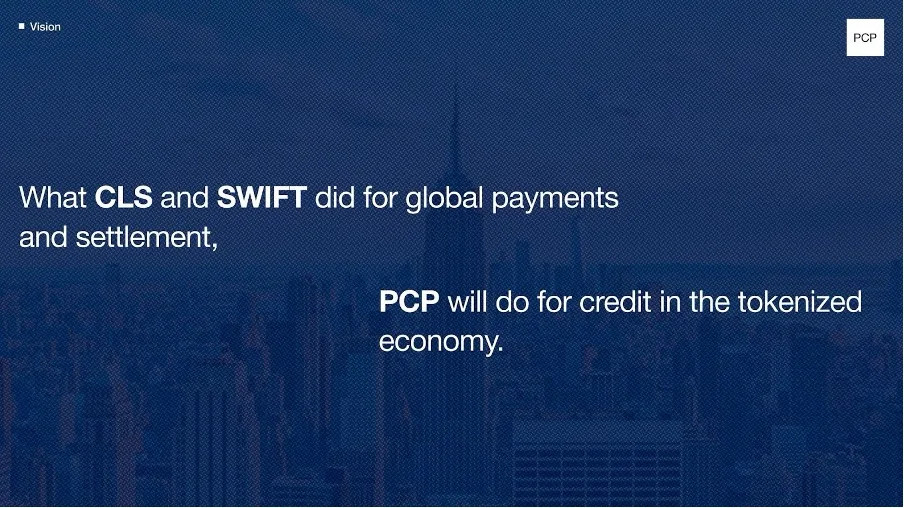
PCP is not a lender. It is not a custodian. It does not take custody of funds at any point. It operates as an infrastructure layer. The vision, in SemiLiquid Labs’ own framing, is that what CLS and SWIFT did for global payments and settlement, PCP will do for credit in the tokenized economy.
4. Credit Lifecycle and Mechanism Design
Figure 4: How the PCP Mechanism Works
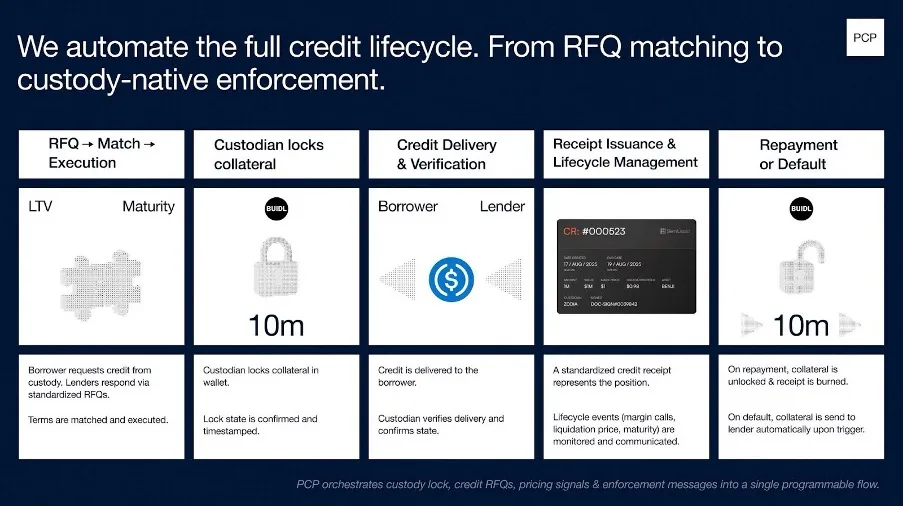
The credit lifecycle under PCP proceeds through five stages. The borrower submits a credit request via standardized FIX messaging through the custody-integrated interface, specifying LTV and maturity. Lenders respond with quotes via the same protocol. Terms are matched and executed bilaterally.
On execution, the custodian locks the collateral in the borrower’s wallet. The lock state is confirmed and timestamped. The collateral cannot be moved, sold, or withdrawn unless an enforcement trigger fires or the loan completes successfully. Credit is then delivered to the borrower. The custodian verifies delivery and confirms state.
A standardized credit receipt is issued representing the position. This receipt is the lender’s security interest: a digital representation of the enforceable claim on the locked collateral. Lifecycle events including margin calls, liquidation price triggers, and maturity are monitored and communicated through the protocol. If a breach occurs, enforcement is deterministic: collateral is sent to the lender automatically upon trigger. On successful repayment, the collateral unlocks and the credit receipt is burned.
The collateral never leaves custody during the normal loan lifecycle, preserving custodial guarantees, regulatory treatment, and ongoing yield accrual for yield-bearing assets like FOBXX. Enforcement is not discretionary: the custodian executes pre-agreed logic based on standardized enforcement messages, with no manual intervention and no reliance on legal process for liquidation. The trade-offs are real. PCP only works with participating custodians, and adoption is gated by custodian onboarding. But these are the correct trade-offs for serving institutional counterparties already operating within custodial infrastructure.
5. A Sample Transaction: Before and After
The pilot conducted at Abu Dhabi Finance Week 2025 provides the clearest illustration of what PCP changes in practice. Franklin Templeton’s BENJI (the tokenized representation of FOBXX) was used as collateral, held at Zodia Custody. The loan was originated and settled on Avalanche with regulated counterparties. This was not a simulation. It was an end-to-end custody-native credit activation using tokenized money-market fund shares as collateral, with the collateral remaining at Zodia throughout the lifecycle.
Consider a concrete capital efficiency comparison. A market maker holds $20 million in FOBXX at Zodia Custody, earning approximately 5% annualized yield. Under the bilateral model, borrowing against this position requires transferring the FOBXX to the lender or a tri-party agent, negotiating a master loan agreement (typically weeks of legal review), and forgoing yield during the transfer and settlement period. Total origination overhead: 80 to 200 basis points, plus yield interruption, plus operational risk during transfer. The fixed cost to establish the credit line alone exceeds $200,000.
Under PCP, the same borrower submits an RFQ through the custody-integrated interface, receives a quote in minutes, and originates an $18 million USDC loan at 90% LTV and 6% annualized interest. The FOBXX remains at Zodia, continues accruing treasury yield, and is locked via custodian policy. A credit receipt is issued to the lender as security. Net cost to the borrower: approximately $7,000 per month ($90,000 in interest minus $83,000 in ongoing yield), or roughly 3.8 basis points of borrowed capital for a 30-day term. PCP’s fee: 0.5 basis points per day on outstanding credit. The entire process, from RFQ to funded loan, takes minutes rather than days.
For lenders, the calculus is equally compelling. The collateral is a regulated, yield-bearing treasury fund held at a qualified custodian. Enforcement is automated and pre-agreed. The credit receipt gives the lender an enforceable claim on the underlying asset without requiring them to custody it.
6. Strategic Implications
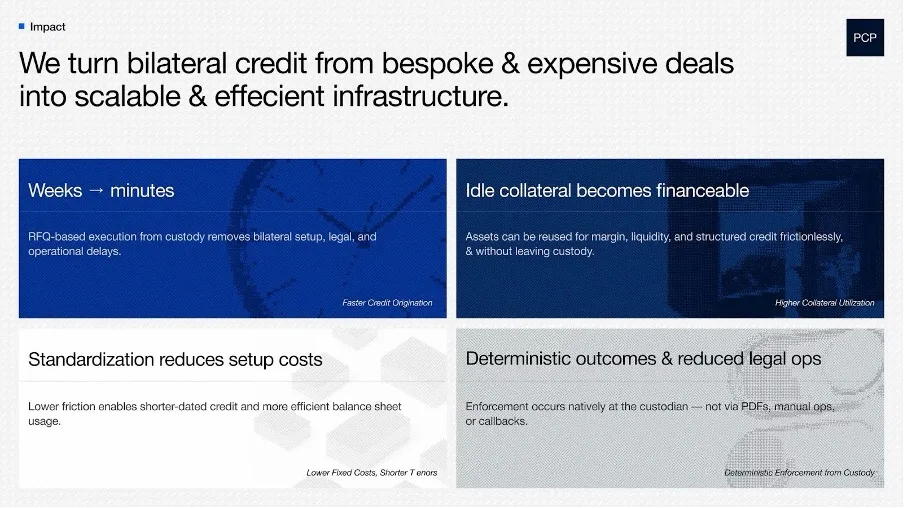
If custody-native credit infrastructure achieves meaningful adoption, it alters several foundational dynamics. First, it collapses the distinction between collateral and custody. Today, an asset is either in custody (safe, regulated, yield-bearing) or posted as collateral (productive but exposed to transfer risk). PCP makes these states simultaneous. Idle collateral becomes financeable collateral. The addressable collateral base expands by an order of magnitude.
Second, it creates a standardized credit primitive for tokenized assets. There is no programmatic way to borrow against BUIDL or FOBXX at institutional scale today. PCP is potentially the credit layer for an entire asset class that does not yet have one.
Third, it shifts the custodian’s role from passive safekeeping to active infrastructure participation. PCP creates a powerful incentive alignment: custodians want more assets under custody, and PCP gives their clients a reason to consolidate with participating custodians. The approximately 50% revenue share between PCP and the custodian reinforces this alignment.
Fourth, credit receipts open a path toward re-use. A lender holding a credit receipt could use it as off-exchange collateral, or receipts could be pooled into tranched on-chain CLO structures for institutional distribution.
Figure 5: A More Scalable and Efficient Credit Structure
7. Why Presto Invested
Presto’s investment in SemiLiquid Labs reflects a structural view on where crypto credit markets are heading. The thesis: institutional adoption is creating a massive pool of custodied collateral that cannot be efficiently financed under existing infrastructure. The credit infrastructure to serve this collateral pool does not exist. SemiLiquid Labs is building it.
As a firm executing over 100 million trades per day, Presto understands the cost of capital inefficiency at operational scale. Every dollar locked in an un-financeable custody arrangement is a dollar that cannot be used for trading, arbitrage, or hedging. Presto participates in PCP’s custody-native lending workflow and its prime broker margin module, which allows prime brokers to scale leverage using third-party secured liquidity without scaling their balance sheet. Presto is validating the system firsthand.
The investment case has asymmetric characteristics. PCP charges 0.5 basis points per day on outstanding credit (approximately 182.5 basis points annualized), plus a 1% fee on liquidation events. Taking Zodia Custody’s approximately $30 billion in assets under custody as an example, even at 2% utilization, the resulting $500 million in average outstanding credit generates approximately $9.1 million in annual gross fees from a single custodian. Scale across multiple integrations, and the economics are substantial. If tokenized assets reach multi-trillion-dollar scale by 2030, the addressable market expands by two orders of magnitude.
The competitive positioning favors early movers. PCP has secured integration with Zodia and Ceffu directly and two WaaS/SaaS channel partners. SemiLiquid Labs is launching a consortium on the Canton Network in May 2026 alongside Cumberland, 21Shares, and The Canton Foundation. These relationships require deep technical integration, FIX messaging implementation, and commercial alignment that cannot be replicated quickly.
Presto’s view is that the crypto market’s next phase of institutional growth will be defined not by new assets but by new infrastructure: specifically, the infrastructure that allows existing assets to be used more efficiently. Custody-native credit rails sit at the center of this transition.
8. Risks and How We Think About Them
No early-stage infrastructure investment is without risk, and we want to be transparent about what we underwrote.
The most significant variable is adoption pace. PCP is only as useful as the custodian network it integrates with. Today, two direct integrations (Zodia, Ceffu) and two WaaS/SaaS channel partners form the initial footprint. Achieving escape velocity requires connecting the majority of institutional custody providers, and each integration involves technical API work, FIX messaging implementation, and commercial alignment. That said, the under-six-week integration timeline and the dual-path approach (direct API for large custodians, SaaS plugin for wallet infrastructure providers) are designed to compress this cycle. More importantly, the Canton Network consortium represents exactly the kind of demand-side signal that accelerates custodian onboarding. Custodians integrate faster when their largest clients are asking for the feature.
Regulatory classification is an area we monitor closely. SemiLiquid Labs’ position is that PCP operates as infrastructure, not as a lender or custodian. The firm does not take custody of funds, does not lend, and does not rehypothecate. This framing appears sound under DIFC and ADGM frameworks, and the involvement of the FIX Trading Community in standardizing the messaging protocol lends additional institutional credibility. As PCP scales across jurisdictions, regulatory treatment will inevitably vary, but the infrastructure-layer positioning and the fact that custodians retain full operational control provide a defensible foundation. The credit receipt’s enforceability is ultimately a legal question tied to the custodian’s contractual obligations. This is a real dependency, but it mirrors the trust model that already underpins institutional custody itself.
On competition, we see the landscape as more validating than threatening at this stage. Prime brokers are beginning to explore cross-custodian margin capabilities, and Basel III capital rules are increasing the cost of balance-sheet-funded leverage, which should expand demand for the kind of external liquidity sourcing PCP enables. DeFi protocols exploring institutional modules have yet to solve the custody compatibility problem. SemiLiquid Labs’ head start in custodian relationships, the FIX-based messaging standard, and the Canton consortium create meaningful first-mover advantages. Moats in infrastructure tend to widen with adoption, not narrow.
We sized this investment with a clear-eyed view of what needs to go right: the Canton consortium must launch with real volume, custodian integration must accelerate, and institutions must prove willing to adopt a new origination workflow. We are comfortable with these conditions because the structural demand is evident, the participants are committed, and our own experience as a borrower on the platform confirms the operational readiness.
9. Conclusion
The collateral movement problem is the binding constraint on institutional credit in digital assets. It persists not because market participants are unaware of it, but because solving it requires building at the custody layer. PCP represents the most credible attempt to date to build standardized, automated credit infrastructure that operates natively within institutional custody, without requiring collateral transfer. This is the kind of infrastructure investment that, if correct, compounds with the growth of the underlying market it serves.