Contents
(1) Macro Backdrop
(2) Crypto Market Moves
(3) Crypto Fund Performance
(4) Positioning and Flows
(5) Takeaways
1. Macro Backdrop
January opened with tentative risk appetite, but conviction faded quickly. Early sessions were dominated by tariff headlines, renewed geopolitical tension, and growing unease around US monetary governance. Trump delayed select tariff increases while floating large-scale MBS purchases, developments around Venezuela and Ukraine continued to inject noise, and Japanese political rhetoric pushed USDJPY through 159 as long-end JGB yields rose sharply.
Rates oscillated throughout the first half of the month as payrolls, CPI, and retail sales were digested against an increasingly politicised Fed backdrop. Concerns intensified mid-month after reports that the Federal Reserve had been served DOJ subpoenas related to prior Chair testimony. The dollar briefly weakened while gold and crypto caught relief bids, but upside proved fleeting.
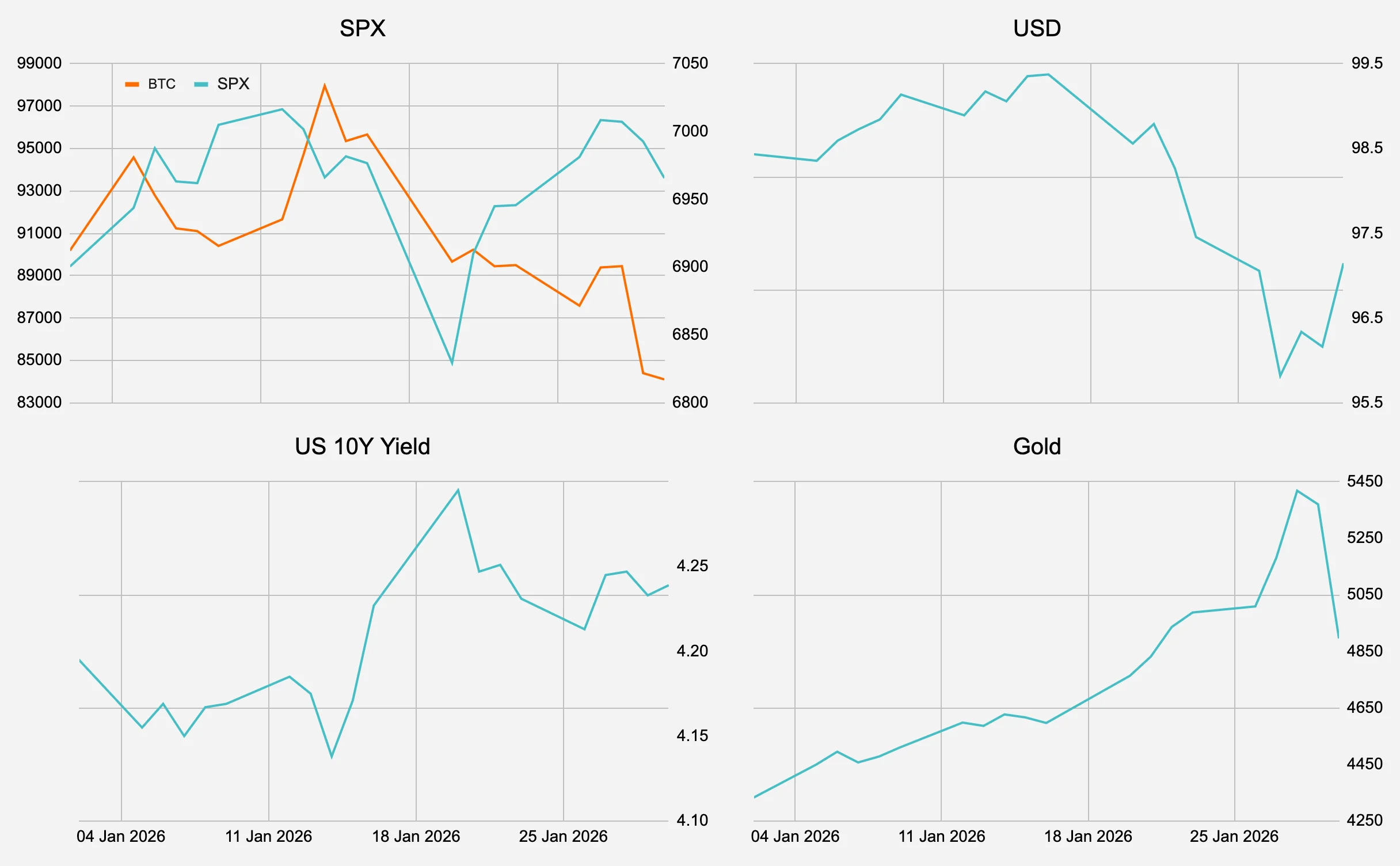
Macro price action in January reflected unstable risk appetite: equities failed to hold early gains, the dollar re-firmed into month-end, yields steepened, and gold extended higher, underscoring persistent demand for defensive hedges amid policy uncertainty (Figure 1).
Figure 1: January price action
Source: Presto Research
Despite repeated attempts to stabilise, trade tensions with Europe and renewed tariff rhetoric capped risk appetite. The January FOMC delivered an in-line hold, attention shifted to the Fed chair nomination, and Trump ultimately announced Kevin Warsh. Into month-end, rates steepened, the dollar firmed, and equities faded, closing January with a cautious tone and unresolved policy overhang.
2. Crypto Market Moves
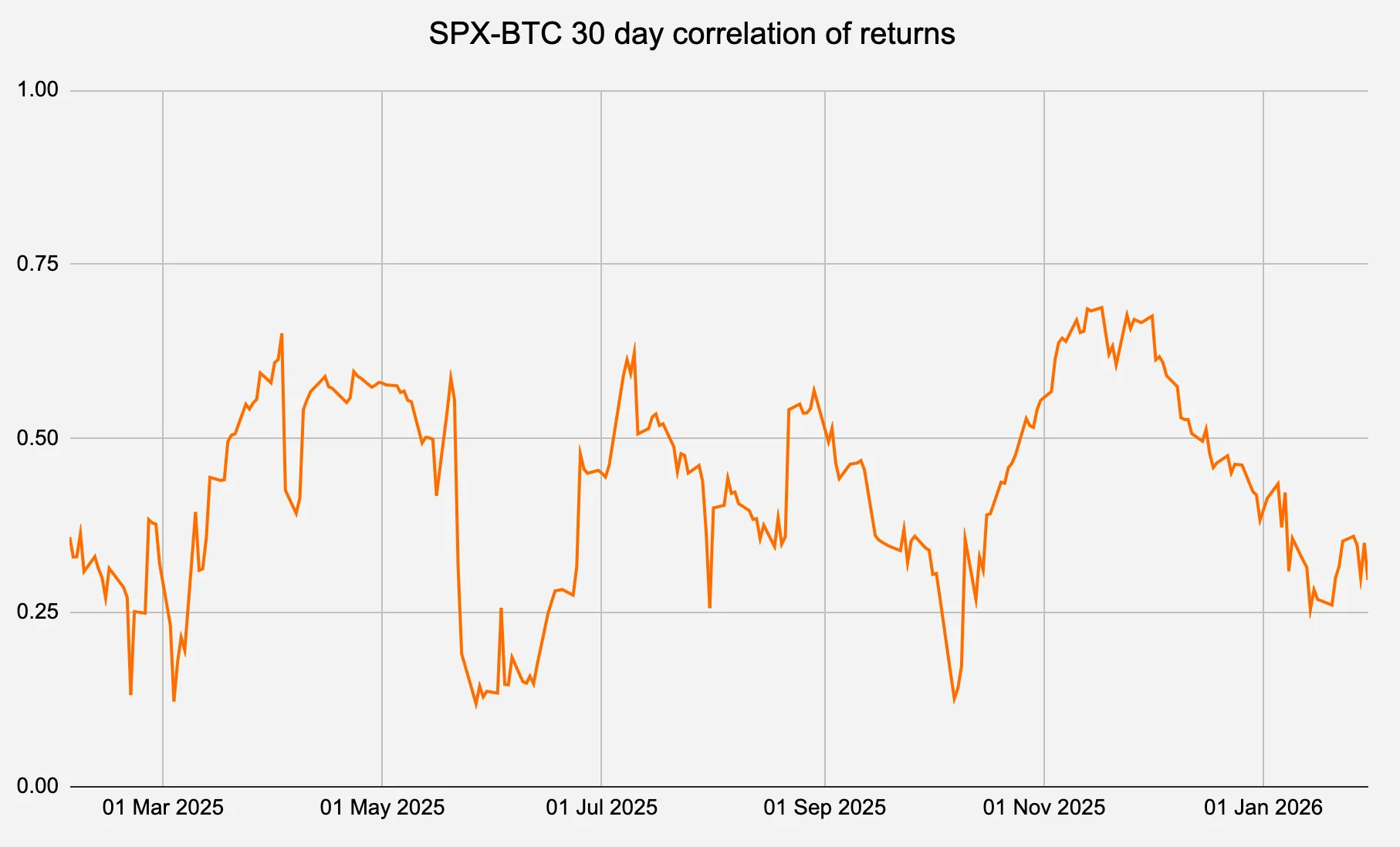
Crypto entered January attempting to stabilise after December’s drawdown, but early strength failed to hold. BTC rallied toward $98k in the first week before rolling over and closing the month below $79k. ETH struggled to clear $3.4k and finished under $3k. The charts show a clear progression: early-month higher highs, followed by stalled rallies, then an accelerated breakdown in the final week as macro risk intensified. The 30-day SPX–BTC correlation moderated into January from late-2025 highs but remained positive, reinforcing that crypto continued to trade as a macro-sensitive risk asset rather than a decoupled alternative (Figure 2).
Institutional participation remained active but uneven. Early flows leaned constructive, with BTC calls lifted at 98k and 100k strikes and ETH call spreads bought. As spot stalled and macro uncertainty deepened, positioning turned more two-sided. Risk reversals printed in the 90k–98k range as traders faded rallies.
Figure 2: Correlations remained well below +0.5 to start 2026
Source: Presto Research
By mid- to late-month, defensive positioning dominated. Front-end implied volatility rose roughly 10 points on risk-off moves, put skew steepened materially, and February 70k BTC puts were lifted as spot sold off into the third week. Large expiries, whale selling, and liquidations compounded weakness into month-end. Despite continued corporate accumulation and long-term institutional engagement, traders closed January carrying protection rather than upside exposure. BTC hovered in the high-$80k area while ETH consolidated near $2.9k, with volatility elevated and skew firm to the downside heading into February.
3. Crypto Fund Performance
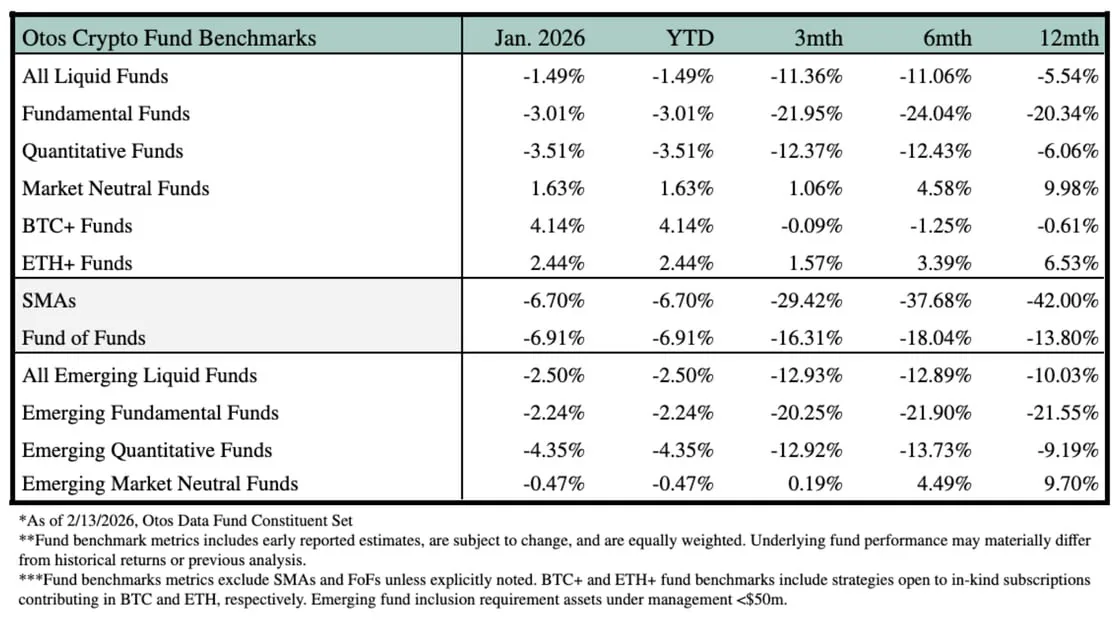
January extended a difficult stretch for active managers. According to Otos preliminary benchmarks, all crypto investment hedge funds declined -1.49% in January.
Strategy dispersion remained pronounced:
Figure 3: Fundamental funds continued to struggle in the new year
Source: Otos Data
While losses moderated relative to November and December, January marked the fourth consecutive month of negative equally weighted performance across both fundamental and quant sub-categories, a sequence not seen since August 2018 to January 2019. Over the past six months, the performance gap has widened materially: fundamental strategies are down -24.04%, quant strategies -12.43%, while market-neutral funds are up +4.58%. Over the same period, BTC is down approximately -31%, ETH -23%, and SOL -47%
January therefore reinforced the structural divide already visible in Q4 2025. Directional and signal-driven approaches continued to struggle in a regime defined by macro whipsaw, policy uncertainty, and inconsistent follow-through. Market-neutral structures, by contrast, again demonstrated resilience, compounding modestly despite deteriorating risk sentiment.
4. Positioning and Flows
January’s flows traced a clear behavioural arc. The month began with constructive positioning and call buying into early strength. As rallies failed, traders rotated into tactical fade structures. By the third week, downside hedging became dominant.
ETF flows fluctuated, with periods of inflow offset by miner distribution, whale selling, and incremental supply. Corporate accumulation remained present but insufficient to offset broader risk reduction. The transition from early optimism to late-month defensiveness was visible not only in skew and vol but in the sequencing of strikes traded: upside calls early, balanced risk reversals mid-month, deep OTM puts into weakness.
Importantly, positioning into month-end was not outright capitulative. Protection was carried, but leverage appeared cleaner relative to October’s disorderly reset. The absence of broad panic suggests stress is building in pockets rather than expressing as systemic liquidation. That distinction matters as the market assesses whether January represents continuation or exhaustion.
5. Takeaways
January underscored how fragile early-year optimism can be in a macro-dominated regime. Policy uncertainty, tariff rhetoric, and questions around central bank independence capped risk appetite and translated directly into crypto weakness after a brief attempt at stabilisation.
For funds, the month extended an already difficult cycle. Four consecutive negative months for both fundamental and quant strategies mark one of the toughest stretches since 2018–2019. Over six months, directional approaches have suffered deeply negative returns, while market-neutral strategies continue to separate from the pack.
The regime remains defined by macro noise and constrained liquidity. Until policy clarity improves or a structural crypto-specific catalyst emerges, rallies are likely to be faded, volatility will remain reactive to headline risk, and adaptability rather than conviction will continue to determine survival into Q1 2026.